
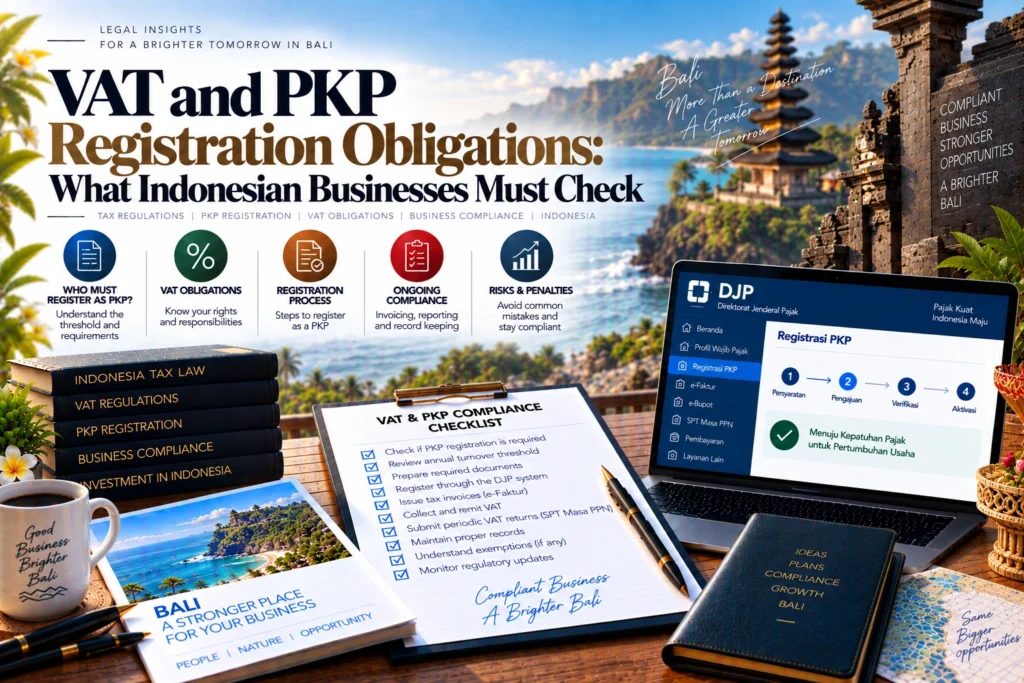
PKP registration is more than a tax-profile update. Once a business enters the PKP regime, it takes on an ongoing VAT compliance cycle involving taxable transactions, tax invoices, payment, input-tax records and monthly VAT returns.
VAT and PKP Registration Obligations: When Does PKP Become Mandatory?
For vat and pkp registration obligations, start with two separate questions: does the business conduct taxable supplies, and has its gross turnover or gross receipts exceeded the small-business threshold?
A company can already have an NPWP, NIB and operating licenses while still needing a separate analysis of whether and when PKP status applies. PKP is the VAT status that creates the obligation to administer VAT on taxable transactions under the applicable rules.
For businesses still mapping their company and licensing setup, Bali Legal ID’s verified OSS RBA Registration Bali guide provides adjacent business-registration context; PKP registration remains a separate tax-compliance question.
The Rp4.8 Billion Turnover Test
The current threshold is Rp4.8 billion in gross turnover and/or gross receipts.
This creates two different routes: mandatory registration after the threshold is exceeded and voluntary registration while the business is still classified as a small entrepreneur for VAT purposes.
Mandatory Registration After Crossing the Threshold
Under Article 17 of Minister of Finance Regulation No. 164 of 2023, an entrepreneur whose gross turnover or gross receipts exceed the small-business threshold during the financial year must report the business for PKP registration no later than the end of that financial year.
This timing matters because older explanations of PKP registration may still refer to an end-of-the-following-month deadline. PMK 164/2023 introduced the current end-of-financial-year timing for the threshold-crossing rule addressed here.
Businesses should therefore monitor cumulative turnover during the year rather than discover the threshold only when annual accounts are finalized. Once the threshold is exceeded, the company should prepare its tax administration, transaction data and invoicing process before the VAT obligations begin.
Voluntary PKP Registration Below the Threshold
A business below Rp4.8 billion can elect PKP status, but the decision should be operational rather than cosmetic.
Voluntary registration can be relevant where customers require valid VAT documentation or where the business model makes input-VAT crediting commercially important. The decision should still be reviewed against the actual taxable supplies, customer profile, costs and administrative capacity of the business.
Once the company becomes PKP, the related VAT duties apply even though its turnover was below the mandatory threshold when it elected registration.
When Do VAT Obligations Start?
For a timely mandatory registration, Article 18 provides that the PKP begins collecting, paying and reporting VAT or VAT and luxury-goods sales tax from the first tax period of the following financial year.
That gives owners a practical transition point. The registration should not be treated as an isolated year-end filing; accounting systems, sales documentation, purchase records and invoice controls should be ready for the first applicable tax period.
If the entrepreneur reports after that deadline or is registered as PKP ex officio, Article 19 provides for VAT obligations from the registration period and addresses VAT that should have been collected from the first tax period of the following financial year.
Late registration can therefore create a backward-looking compliance issue, not simply a delayed administrative status.
What Changes After PKP Registration?
Once registered, the DGT states that a PKP must collect, deposit and report VAT and applicable luxury-goods sales tax.
Operationally, this changes the accounting workflow. Revenue, taxable supplies, output VAT, purchase invoices and input VAT need to reconcile with the monthly tax reporting process.
Tax Invoices and Output VAT
DGT guidance on VAT collection lists issuing tax invoices for taxable supplies among PKP obligations and identifies crediting eligible input VAT as a PKP right.
Tax invoices should therefore be controlled at transaction level. The sales ledger, invoice data and VAT return should describe the same taxable supplies.
For businesses with different revenue streams, first determine whether each transaction is taxable under the applicable VAT rules. A company’s PKP status does not mean every receipt has identical VAT treatment.
Input VAT and Supporting Records
Input VAT can be economically important, but it should not be treated as an automatic percentage deduction from all business costs.
Maintain supplier tax invoices and supporting transaction records so the business can determine which input VAT is creditable under the applicable rules and which amounts require different treatment.
This is especially relevant for new investments where significant taxable purchases occur before the business reaches stable revenue. The input-tax file should be built as part of the accounting process rather than reconstructed only when the VAT return is due.
Monthly VAT Returns
This means PKP status creates a recurring monthly obligation even during quiet periods. A newly registered company should therefore establish responsibility for invoice issuance, purchase-document collection, reconciliation, payment and return filing before the first deadline arrives.
How the Current VAT Rate Works
The headline 12% rate does not mean every ordinary transaction produces a 12% effective burden on the full selling price.
Businesses should therefore configure invoices and accounting systems according to the transaction’s actual VAT treatment rather than applying a single percentage mechanically to every sale.
Special tax bases, sector-specific VAT amounts, exempt supplies, facilities and luxury goods can require different treatment. A transaction-specific review is particularly important for businesses with mixed activities, property-related income, tourism services or several revenue categories.
PKP Readiness Checklist for Bali Businesses
First, map every revenue stream and identify which activities involve taxable goods or taxable services.
Second, monitor cumulative gross turnover and receipts against the Rp4.8 billion threshold throughout the financial year.
Third, if the threshold is exceeded, record the month in which it happened and prepare the PKP application before the end of the relevant financial year.
Fourth, decide whether a sub-threshold business has a genuine commercial reason to elect voluntary PKP status. Consider customers, supply-chain VAT, input-tax records and the administrative workload that follows.
Fifth, prepare the accounting system before the first VAT period. Sales invoices, tax invoices, supplier documents, output VAT and input VAT should be reconcilable.
Sixth, assign responsibility for the monthly VAT return. The filing obligation continues even when there are no taxable supplies in the period.
Seventh, verify the VAT calculation used by each major revenue stream. Do not assume that the statutory 12% headline rate always means 12% of the full transaction value.
Finally, review PKP and VAT status when the business model changes. New services, property transactions, additional business activities or major expansion can change the transaction mix even when the legal entity remains the same.
Conclusion
PKP registration is a threshold and compliance issue, not merely another company-registration document. Businesses making taxable supplies should monitor the Rp4.8 billion small-business threshold, understand whether registration is mandatory or voluntary and prepare for the monthly VAT obligations that follow.
For a business that exceeds the threshold during its financial year, PMK 164/2023 sets the current registration deadline at the end of that financial year, with timely mandatory VAT obligations beginning from the first tax period of the following financial year. From that point, VAT collection, tax invoices, input-tax controls, payment and monthly reporting should operate as one integrated accounting process.
Prepare the Tax System Before PKP Obligations Begin
If your Bali business is approaching the PKP threshold, considering voluntary registration or reviewing an existing VAT process, Bali Legal ID can be consulted to coordinate the tax, accounting and wider business-compliance review.
Tax consulting, accounting services and financial-report preparation can be used to align transaction records, VAT documentation and recurring reporting obligations; no separate verified service URL was supplied for this package.
Read more: Tax Consultant Bali
For help scoping the documents and next steps for your business or transaction, contact Bali Legal ID about our financial consultant services in Bali.
Read More: Financial Consultant in Bali for Tax, Accounting & Financial Reporting Services
FAQ vat and pkp registration obligations
When is PKP registration mandatory in Indonesia?
For the threshold rule discussed here, an entrepreneur whose gross turnover or gross receipts exceed Rp4.8 billion during the financial year must report the business for PKP registration under PMK 164/2023.
What is the current deadline after turnover exceeds Rp4.8 billion?
PMK 164/2023 provides that the business must report for PKP registration no later than the end of the financial year in which the threshold was exceeded.
Can a business below Rp4.8 billion register as PKP?
Yes. Current DGT guidance confirms that a small entrepreneur below the threshold may voluntarily choose PKP registration.
When do VAT obligations begin after timely mandatory registration?
For the threshold-crossing route under PMK 164/2023, VAT collection, payment and reporting begin from the first tax period of the following financial year.
Does a PKP need to file a VAT return when there were no taxable sales?
Yes. Current DGT guidance states that the Monthly VAT Return remains due even when the PKP made no taxable supplies in that tax period.
Is VAT always 12% of the selling price in 2026?
No. The statutory rate is 12%, but PMK 131/2024 generally uses an 11/12 tax base for non-luxury taxable goods and taxable services, which produces an effective burden equivalent to 11%, while special regimes and luxury goods can differ.
References & Sources
- Directorate General of Taxes — Entrepreneur Tax Obligations — pajak.go.id
- Minister of Finance Regulation No. 164 of 2023 — PKP Registration and Turnover Rules — pajak.go.id
- Directorate General of Taxes — VAT Collection and PKP Obligations — stats.pajak.go.id
- Directorate General of Taxes — Monthly VAT Return — pajak.go.id
- Law No. 7 of 2021 — Harmonization of Tax Regulations — peraturan.bpk.go.id
- Minister of Finance Regulation No. 131 of 2024 — VAT Treatment from 2025 — jdih.kemenkeu.go.id
Recommended Next Articles
- OSS RBA registration for Bali businesses — balilegalid.com